
20th Anniversary of the Tiptree Award. Ceremony at WisCon 35.
May 2011
Tiptree Month.
Alice Sola Kim, Beautiful White Bodies
Here is the annotation for Kim’s story: A dangerous plague is turning high school girls into ravishing beauties. We found this story’s illumination of teenage girlhood and its passionate desires to be a quite heartbreaking meditation on the meaning of beauty and femininity in the media and popular culture. Especially lovable — the main character. Especially pertinent to us — our protagonist’s hopeless assurances that really, girl geeks can grow up okay. Especially fabulous — the marvelous voice of the piece and the amazing ending.
At least one person on the jury that year believed that feminism is currently located in intersectionality; that it’s no longer possible much less desirable to discuss gender and divorce it from race and class, etc. The primary focus of the Kim story is on a traditional issue of feminism, ie ,physical female beauty. But it also provides a textbook example of intersectionality, particularly with regard to race. I thought we could start there, with the story’s various intersectionalities and then, of course, go wherever you all would like.
The story is available online here: Strange Horizons Fiction: Beautiful White Bodies, by Alice Sola Kim.
Jo Walton, LIFELODE
I’ve been slow with this as I hoped to reread it before our discussion. I’m well on my way with that though not yet finished, but there is no reason my tardiness should delay the discussion any longer.
Here is what the jury said:
“We are all familiar with books in which the setting is some sort of fantasy/feudal blend and the gender roles appear unexamined and uninteresting. So one thing we loved about Lifelode was the way the society’s hierarchical, feudal social structure included both a traditional view of marriage, through which hereditary power is passed on, and an established tradition of polyamorous relationships. Life here is comfortable and relatively egalitarian; through Walton’s characters, we see the power inherent in traditionally feminine social roles. But Lifelode takes place at just that moment when the cozy village of Applekirk finds itself threatened by an alien and terrifying new monogamous order…”
One of the things I admired about this book was its clever reversal of social arrangements so that polyamory represents a kind of cozy pre-industrial stability and monogamy an unnatural, restrictive, and unreasonable demand.
I think the book says some interesting things about the work traditionally assigned to women — there is something extremely pleasurable to me in the cooking scenes and in the magical responsive house — and I’d love to talk about those.
It has nothing to do with gender, but the way time is played about with, especially in the beginning of the book is very deft and impressive conceptually and maybe does shadow in some way the fluidity of Applekirk’s sexual and romantic mores.
And I’m sure you all have things you’d like to talk about, too. Whenever you’re ready!
Caitlin R. Kiernan, Galápagos
Here is what the jury had to say:
Although we immediately loved this story, our initial reaction was that the centrality of a same-sex relationship in the place we might expect a heterosexual one wasn’t enough to persuade us that our understanding of gender was being explored and expanded. But the more we thought and talked about it, the more things we felt the story accomplished. Because a queer relationship does have a different connection to the reproduction of the species, to have a disturbing alien reproductivity routed through queer female bodies did feel radical and new. “Galapagos” made us think of the work of Octavia Butler. There can be no higher praise
Possible discussion questions:
Motherhood always suggests some form of cannibalization of the mother’s body. Does this story speak to that or is the act of reproduction here so alien as to say nothing about ordinary human reproduction?
What do we make of the title and references to Darwin?
There is a docility in the woman in the hospital and also, arguably, in her lover in the spaceship. What do you make of this passivity?
What is the role of science in the story? Of religion? Of love?
“Useless Things” by Maureen McHugh
“Useless Things” by Maureen McHugh, in Eclipse 3, edited by Jonathan Strahan (Night Shade Books, 2009)
Moderated by Karen Joy Fowler
Welcome to our long-promised, oft-delayed bookclub. We always hoped that the Tiptree Award would, among other things, prompt a good conversation about the books and stories honored, and the issues they raised. Every year this conversation has occurred for the five people serving as jurors. Our hope here is to extend it further.
The format for this book club is a work in progress. One thread on each work will focus on the gender aspects of the story in hand, but I expect there will be many other things to be noted, as well. I personally dislike book clubs where the talking is fragmented into a variety of threads, so I’d like to keep things pretty tight. But, with your input, we’ll be making that up as we go.
We’re starting with some short fiction to give you all time to read the novels, and we’re starting with the most recent Tiptree Award list.
Here is what the jury said about “Useless Things”:
“A non-reproductive woman makes idealized child-objects in an uncertain world. McHugh’s story takes place only a tick away from where we now find ourselves, in a pressured environment of economic collapse where any act of generosity and open-heartedness is risky and a good person is a dangerous thing to be. This is not fundamentally a gendered issue, but it often expresses itself in gendered ways. An incredibly evocative, sparely written, powerful story.”
Of course, we should launch the club by talking about the apocalypse! McHugh’s near future stories, at least to me, are among the most plausible visions of what’s coming. I note in this one, the sense that the future will arrive unevenly, first to certain classes, ethnicities, and geographical areas. It is arguably already here.
I note her belief that it will not make us better people. It will do the opposite.
I note also the moment late in the story when Maureen directly addresses other apocalyptic works, the paragraph that ends with the Byronic desert.
My suggestions for things to talk about:
- We are science fiction writers and readers here. How good have we been at predicting the things we now see collapsing about us? Which apocalyptic visions seem real to you?
- Is there a hubris in thinking, as so many generations before us have also thought, that we live in some version of the end times? Do we live in some version of the end times?
- I personally was deeply taken with this story because of its clear-eyed presentation of a central dilemma in my own life – when can I afford to get involved? I never pass a hitchhiker without wishing I could pick him/her up and I never do pick up hitchhikers. I feel that my caution, that my own sense of being at risk in the world, is feminine, but I’m not sure of that.
In both the story at hand and the real world around the story, how is this a gendered issue and how is it not? - Is there an inevitable conflict between our ability to make the world a better place and our personal survival? Are these two things always bound to come into conflict, sooner or later?
- Besides the obvious, how will the apocalypse arrive differently to those of different genders and sexual identities?
Over to you.
Upcoming
I’d like, at least, at first here to focus on the honor list on the assumption that the winners are more likely to have already gotten some well-deserved attention. My plan for the next couple of months:
- After the McHugh story, let’s look at — “Galápagos” by Caitlín R. Kiernan in the same anthology
- And after that, I’d like to turn to our first novel — Jo Walton’s Lifelode.
Welcome to the Tiptree Award Book Club!
Welcome to the Book Club!
We’ll be starting here on March 1, with a discussion of “Useless Things” by Maureen McHugh, which was on the honor list for the 2010 award. “Useless Things” can be found in Eclipse 3, edited by Jonathan Strahan, and in the 25th edition of Gardner Dozois’ World’s Best Science Fiction.
Please read, come, and participate by commenting!
Coming soon
Karen Joy Fowler leads a Tiptree-related reading group bookclub.
2010 Otherwise Award Winners Announced!
2010 Tiptree Award Winner Announced!
The James Tiptree, Jr. Literary Award Council is pleased to announce that the 2010 Tiptree Award is being given to Baba Yaga Laid an Egg, by Dubravka Ugresic (Canongate, 2010).
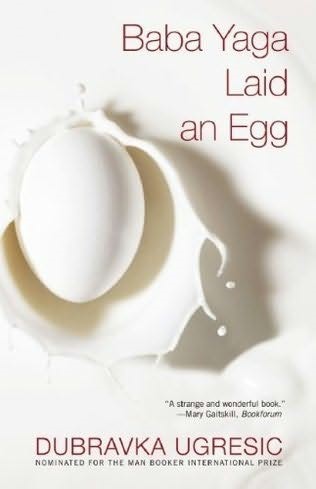
Baba Yaga Laid an Egg impressed with its power and its grace. Tiptree juror Jessa Crispin explains that the beginning of the book
“does not scream science fiction or fantasy. It starts quietly, with a meditation on the author’s aging mother, and the invisibility of the older woman…. But things shift wholly in the second act, with a surreal little tale of three old ladies, newly moneyed, who check into an Eastern European health spa. There’s another revolution in the third act, where what looks like a scholarly examination of the Russian fairy tale hag erupts into a rallying cry for mistreated and invisible women everywhere.”
Crispin notes that the fairy tale figure Baba Yaga is the witch, the hag, the inappropriate wild woman, the marginalized and the despised. She represents inappropriateness, wilderness, and confusion.
“She’s appropriate material for Ugresic, who was forced into exile from Croatia for her political beliefs. The jurors feel Baba Yaga Laid an Egg is a splendid representation of this type of woman, so cut out of today’s culture.”
Honor List
The Honor List is a strong part of the award’s identity and is used by many readers as a recommended reading list for the rest of the year. This year’s Honor List is:
The Bone Palace by Amanda Downum (Orbit 2010) — noted for a deliciously complicated plot that challenges 21st century Earth attitudes toward transfolk. One juror noted that this book came closest among the honor list to meeting her Tiptree ideal by including a character that not only embodies a challenge to prescribed roles, but also creates a crack in or addition to the structure that carries forward to future generations.
The Hundred Thousand Kingdoms by N.K. Jemisin (Orbit 2010) — set in a matriarchal society where the privilege and expectations between the sexes are reversed, while the gender roles are different but recognizable (and believable).
Diana Comet and the Disappearing Lover by Sandra McDonald (published as “Diana Comet,” Strange Horizons, March 2 & March 9, 2009) — a (true) love story, in which the author does something simple but radical with the identity issues at play.
Drag Queen Astronaut by Sandra McDonald (Crossed Genres issue 24, November 2010) — a wonderful exploration (and ultimately an affirmation) of a gender presentation that tends to be ignored or ridiculed.
The Secret Feminist Cabal by Helen Merrick (Aqueduct Press 2009) — an academic look at the history of early feminism in science fiction, science fiction criticism, and fandom that provides a valuable documentation of our beginnings
Who Fears Death by Nnedi Okorafor (DAW 2010) —A strong female lead character breaks out of restrictive gender roles to change her life, perhaps changing history as a result. A well-written perspective on prejudice and discrimination and the lessons needed to overcome their bonds on our identities and imaginations.
Living with Ghosts by Kari Sperring (DAW 2009) — an unusual perspective in a main character —a feminized man who makes much of his living as an escort/high-class sex worker who sees ghosts when he is not expecting — or expected — to be able to do so. An excellent read.
The Colony by Jillian Weise (Soft Skull Press 2010) — Takes on the idea that pervades our culture that women have to be perfect in order to have sex with men. One juror notes: “I’ve never read a book that made a woman with one leg so sexually normal.” Smart and well written with subtle gender politics.
In addition to the honor list, this year’s jury also compiled the following “long list” of additional works they found worthy of attention:
Beth Bernobich, Passion Play (Tor 2010)
Stevie Carroll, “The Monitors” (in Echoes of Possibilities, edited by Aleksandr Volnov, Noble Romance Publishing 2010)
Roxane Gay, Things I Know About Fairy Tales (Necessary Fiction, May 13, 2009)
Frances Hardinge, Gullstruck Island (MacMillan 2009)
Julia Holmes, Meeks (Small Beer Press 2010)
Malinda Lo, Ash (Little, Brown 2009)
Alissa Nutting, Unclean Jobs for Women and Girls (Starcherone Books 2010)
Helen Oyeyemi, White Is for Witching (Doubleday 2009)
Rachel Swirsky, Eros, Philia, Agape (Tor.com, March 3, 2009)
This year’s jurors were Penny Hill (chair), Euan Bear, Jessa Crispin, Alice Sola Kim, and Lawrence Schimel.