
10 Ways to Keep Books You Love in Print

Book Lady
Book Lady

There are books you love, books that change your life, books that make you realize that you aren’t alone. But sometimes, those books go out of print and are no longer available. You gnash your teeth and curse the vagaries of publishing. You feel helpless and frustrated, but you know that there’s nothing you can do about it.

Not so! You can do something! Publishing is a capitalist enterprise, driven by sales and profit (as well as a love of books). But even if you’re too broke to buy a paperback book, you can influence book sales and affect a publisher’s profits.

What can you do?

#1 Review the book you love online in a newsgroup, on a webzine, on an e-commerce site, or on a personal web site. This is an easy way to tell a lot of people about a fabulous book. People pay attention to reviews. Hey—authors read reviews. With a good review, you can make an author’s day.

“Of course I read my reviews on Amazon.com. I know I shouldn’t, but I can’t help myself. When readers write and say they loved my work, I’m ridiculously happy for days.”

— Pat Murphy, author of There and Back Again

#2 When asked what you want for your birthday, or Hanukkah, or Christmas, or any other gift-giving occasion, answer with your favorite author’s current book.

“Ask for books as presents! Not only do you get a present you like, you get bonus karma points because you’ve been a decent human being and haven’t forced your friends to rack their brains and run all over town looking for some gift for you that you probably wouldn’t have liked anyway.”

— Michaela Roessner, author of The Stars Compel

#3 Give books as presents. If someone has a favorite author, buy that author’s latest title. If the gift recipient doesn’t have a favorite author, buy a book by an author you like. If your friend likes the book, you’ve done the author a big favor by creating a new fan.

#4 Ask for books by your favorite author at your local library. If the library doesn’t have a book, request it. Checking a book out of the library helps establish that there’s a demand for that author’s work. Demand leads library systems to buy books.

#5 Tell writers how much their work has affected you. Go to readings—even if you can’t afford to buy the book. Urge your local library bookstore or your school to invite the writer to do a talk, a reading, or a class visit. Sometimes writers just need to know that someone is listening.

“I remember the first time anyone ever made a comment to me about a published story. Since writers aren’t allowed to carry Tip Jars, this kind of validation is quite meaningful.”

— Leslie What, author of The Cost of Doing Business

#6 Talk about books and authors at work, among friends, and in other not-necessarily literary environments. If you belong to a writing group, recommend your favorite authors to the group. If you add a book to your reading group, tell your favorite bookstore what you’ve done and buy your books there. The bookstore may put them out front on display.

“I named my dog Rhodry after a character in Katharine Kerr’s Deverry novels. This has led directly to at least a dozen people reading her books, including my sister, who has now read most of them twice. (‘That’s an interesting name, where does it come from?’) My truck is named Tesah, after a starship in Rebecca Meluch’s first novel. I got a couple of people to read her work as a result, but you don’t call your truck as often as you call your dog—at least I don’t.”

—Susanna J. Sturgis, editor of The Women Who Walk Through Fire: Women’s Fantasy and Science Fiction

#7 Point to good books in the bookstore and tell people, even total strangers, “That one is great.” If you see someone looking at a copy of a book you like, encourage them to buy it.

“I like to turn waiting time (especially in airports) into a guerrilla act—I find my favorite authors’ books in the bookstore and turn them boldly facing out. Then I run for my plane before a clerk catches me.”

—Ellen Klages, author of Time Gypsy

#8 Carry around a copy of a book you love. Read it on buses, in waiting rooms, and in other public places. Be prepared to wax eloquent about it—spontaneously or only when asked; that’s up to you.

“Ooh ooh, I’ve got a wicked idea! Make book covers out of your favorite titles and put ‘em on whatever book you’re reading!”

—Susanna J. Sturgis

#9 Just because a book is out-of-print doesn’t necessarily mean you can’t get it. Lightning Print Inc. is currently asking for suggestions for books to reprint. You can vote now at their web site: www.lightningsource.com. Then from their “Resources” menu select “Nominate titles for POD and eBook”, then tell them what books you’d like to see reprinted!

#10 Nominate your favorite authors for awards. Any year that you are a member of the World Science Fiction Convention, you can nominate and vote for the Hugo Award. Nominate gender-bending works for the James Tiptree Jr. Memorial Award and works with gay or lesbian content for the Lambda Literary Award. If you subscribe to Locus Magazine, you can nominate works for the Locus Poll and Survey. And yes, it’s worth taking the time—awards make a difference to an author’s sales and that helps keep books in print.

Above all else, keep reading!
Read more books!
Eat more cookies!
2008 Otherwise Award Winners announced!

A gender-exploring science fiction award is presented to Patrick Ness for The Knife of Never Letting Go and Nisi Shawl for Filter House.

The Knife of Never Letting Go by Patrick Ness and Filter House by Nisi Shawl

The James Tiptree, Jr. Literary Award Council (otherwiseaward.org) is pleased to announce that the 2008 Tiptree Award has two winners: Patrick Ness’s young adult novel, The Knife of Never Letting Go (Walker 2008) and Nisi Shawl’s short story collection, Filter House (Aqueduct Press, 2008).

The Tiptree Award will be celebrated on Memorial Day weekend at WisCon in Madison, Wisconsin. Each winner will receive $1000 in prize money, an original artwork created specifically for the winning novel or story, and (as always) chocolate.

A panel of five jurors selects the Tiptree Award winners and compiles an Honor List of other works that they find interesting, relevant to the award, and worthy of note. The 2008 jurors were Gavin J. Grant (chair), K. Tempest Bradford, Leslie Howle, Roz Kaveney, and Catherynne M. Valente.

The Knife of Never Letting Go begins with a boy growing up in village way off the grid. Jury chair Gavin J. Grant explains, “All the villagers can hear one another’s thoughts (their “noise”) and all the villagers are men. The boy has never seen a woman or girl so when he meets one his world is infinitely expanded as he discovers the complications of gender relations. As he travels in this newly bi-gendered world, he also has to work out the definition of becoming and being a man.”

Juror Leslie Howle praises Ness’s skills as a writer: “Ness is a craftsman, plain and simple. The language, pacing, complications, plot this story has all of the elements that raise the writing to something well beyond good. Some critics call it brilliant. It’s a page-turner, and the story continues to resonate well after reading it. It reminds me of the kind of classic SF I loved when I was new to the genre.”

In addition to the Tiptree Award, The Knife of Never Letting Go also won the 2008 Booktrust Teenage Prize (U.K.), which celebrates contemporary fiction for teenagers, and the Guardian Children? Fiction Prize.

Publishers Weekly, which selected Filter House as one of the best books of 2008, described it as an “exquisitely rendered debut collection” that “ranges into the past and future to explore identity and belief in a dazzling variety of settings.” Tiptree jurors spotlight Shawl’s willingness to challenge the reader with her exploration of gender roles.

Juror K. Tempest Bradford writes, “The stories in Filter House refuse to allow the reader the comfort of assuming that the men and women will act according to the assumptions mainstream readers/society/culture puts on them.”

Juror Catherynne M. Valente notes that most of Shawl’s protagonists in this collection are young women coming to terms with womanhood and what that means “in terms of their culture, magic (almost always tribal, nuts and bolts, African-based magical systems, which is fascinating in itself), [and] technology.” In her comments, Valente points out some elements of stories that made this collection particularly appropriate for the Tiptree Award: “‘At the Huts of Ajala’ struck me deeply as a critique of beauty and coming of age rituals. The final story, ‘The Beads of Ku,’ deals with marriage and motherhood and death. ‘Shiomah’s Land’ deals with the sexuality of a godlike race, and a young woman’s liberation from it. ‘Wallamellon’ is a heartbreaking story about the Blue Lady, the folkloric figure invented by Florida orphans, and a young girl pursuing the Blue Lady straight into a kind of urban priestess-hood.”

Buy this year’s Tiptree Award winners as well as winners from the past.

The Tiptree Award Honor List is a strong part of the award? identity and is used by many readers as a recommended reading list for the rest of the year. This year’s Honor List is:

  • Christopher Barzak, The Love We Share Without Knowing (Bantam, 2008)
  • Jenny Davidson, The Explosionist (HarperTeen, 2008)
  • Gregory Frost, Shadowbridge and Lord Tophet: A Shadowbridge Novel (both published by Del Rey, 2008)
  • Alison Goodman, Two Pearls of Wisdom (HarperCollins Australia 2008), published in the United States as Eon: Dragoneye Reborn (Viking 2008), also Eon: Rise of the Dragoneye in the United Kingdom
  • John Kessel, Pride or Prometheus (Magazine of Fantasy and Science Fiction, January 2008)
  • Margo Lanagan, Tender Morsels (Knopf, 2008)
  • Ursula K. Le Guin, Lavinia (Harcourt)
  • John Ajvide Lindqvist, Let the Right One In (Quercus (UK) 2007), original Swedish title Låt den rätte komma in (2004), first published in English as Let Me In, St. Martin’s Press (2007), Translated by Ebba Segerberg)
  • Paul Park, A Princess of Roumania (Tor, 2005), The Tourmaline (Tor, 2006), The White Tyger (Tor, 2007), The Hidden World (Tor, 2008)
  • Ekaterina Sedia, The Alchemy of Stone (Prime Books)
  • Ali Smith, Girl Meets Boy (Canongate U.S., 2007)
  • Ysabeau S. Wilce, Flora’s Dare: How a Girl of Spirit Gambles All to Expand Her Vocabulary, Confront a Bouncing Boy Terror, and Try to Save Califa from a Shaky Doom (Despite Being Confined to Her Room) (Harcourt, 2008)

Buy this year’s Tiptree Award honored books.

Reading for the 2009 Tiptree Award will soon begin. As always, the Tiptree Award invites everyone to recommend works for the award. Please submit recommendations to nominate@otherwiseaward.org.

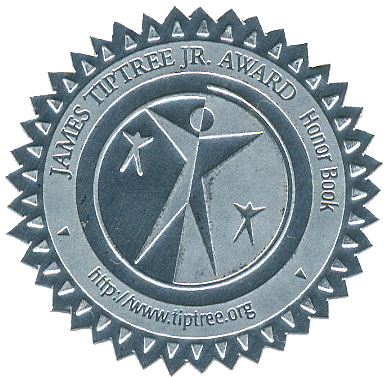
Tiptree Honor Book Logo Stickers

Available now:

Tiptree Honor Book Logo Sticker

Lovely silver and gold stickers to promote Tiptree winners and honor books (and stories). If you wrote or published a Tiptree honoree and would like some, please let us know.